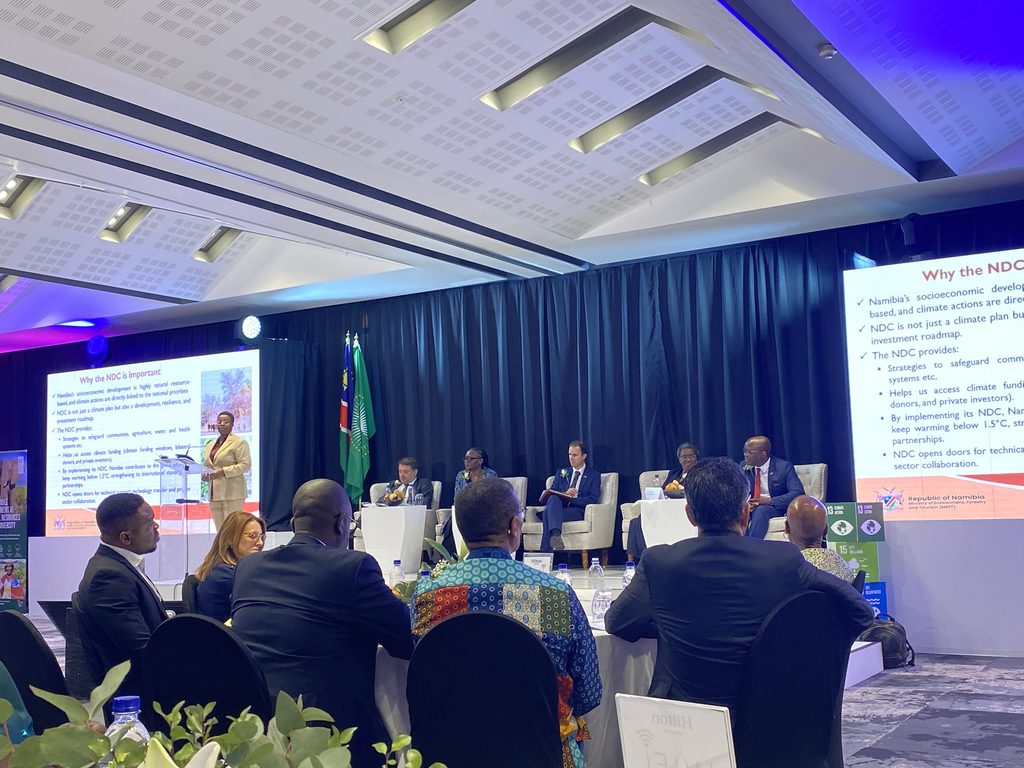
Namibia has officially launched its Third Nationally Determined Contribution (NDC 3.0) under the Paris Agreement, marking an important step in strengthening the country’s response to climate change and building a more climate-resilient future.
Launched in Windhoek on 25 September 2026 under the theme “Towards a Climate-Resilient Namibia: Advancing Climate Solutions through Namibia’s NDC 3.0,” the new NDC sets out Namibia’s climate priorities through 2035, covering both climate mitigation and adaptation.
NDCs are national climate action plans in which countries outline how they will reduce greenhouse gas emissions and adapt to climate change impacts. The NDC 3.0 process follows the Paris Agreement’s global stocktake and aims to strengthen ambition and accelerate implementation.
A stronger focus on resilience
For Namibia, climate change is not a distant concern. Communities across the country are already experiencing drought, water scarcity, floods, extreme heat and land degradation. NDC 3.0 therefore places significant emphasis on adaptation and resilience across sectors including water, agriculture and food security, biodiversity, fisheries, health, infrastructure, coastal areas and urban settlements.
The plan identifies nine adaptation priority areas, 46 adaptation measures and 110 actions. On mitigation, it includes 26 measures and 106 actions across areas such as energy, agriculture, forestry and other land use, industry and waste.
This represents an important recognition that climate action must be connected to the everyday realities of Namibians — including access to water and food, sustainable livelihoods, energy, healthy ecosystems and resilient communities.
Climate ambition requires climate finance
One of the most significant issues emerging from NDC 3.0 is the scale of investment required to turn these commitments into reality. The implementation of NDC 3.0 is estimated to require approximately US$14.07 billion through 2035, with around 88% of the required financing conditional on international climate finance, technology transfer and capacity-building support.
This highlights an important reality: climate ambition must be matched with accessible and equitable finance. For communities and young people, climate finance cannot remain an abstract discussion. It must translate into practical investments that strengthen local resilience, create decent green jobs, support climate-smart livelihoods, improve access to clean energy and water, and enable communities to participate meaningfully in decisions that affect their future.
What does NDC 3.0 mean for young people?
For Namibia’s young population, the implementation of NDC 3.0 presents both a responsibility and an opportunity. Young people should not only be viewed as beneficiaries of climate policies. They are partners, innovators, entrepreneurs, researchers, community organisers and leaders who can contribute directly to implementation.
Youth participation must therefore extend beyond consultation. Young people should have meaningful opportunities to contribute to the design, financing, implementation and monitoring of NDC actions at national, regional and community levels. This includes strengthening youth involvement in areas such as renewable energy, sustainable agriculture, water security, biodiversity conservation, circular economy initiatives, climate technology, disaster risk reduction and climate finance.
From a climate document to implementation
The launch of NDC 3.0 is an important milestone, but the real measure of its success will be what happens after the launch. As highlighted during the launch, Namibia’s climate commitments must ultimately result in water security, food security, resilient infrastructure, protected ecosystems, reliable energy, productive land and opportunities for young people. For Youth4CAN, this means keeping implementation at the centre of the climate conversation.
We believe Namibia’s NDC 3.0 should be understood not only as a climate commitment, but as an opportunity to strengthen inclusive and locally driven development. Implementation must reach communities, particularly those most exposed to climate impacts, while ensuring that young people have the knowledge, resources and platforms needed to contribute.
The next chapter is therefore not simply about meeting targets. It is about building a Namibia where climate action contributes to climate justice, resilient communities, sustainable livelihoods and a future in which young people can thrive.
NDC 3.0 is launched. Now, the work of implementation begins.